

Structural Failure
Don't Try This at Home

At one point in my life, I thought it was a good idea to build a gingerbread house for the holidays.
That moment passed. This year, I came across the gingerbread house mold in a drawer and debated whether or not to throw out the thing that had been occupying space for well over a decade. I texted my neighbor Andy, who once asked me if he could observe my “process” while making Christmas cookies. I asked him if he wanted to build a gingerbread house.
“Let’s do it,” he texted back.
Andy, the kind of guy who returns to Los Angeles from Colorado via Marfa, is an architect. It turns out that Andy recently quit his day job and decided to start his own practice. When he wasn’t converting his garage into a workspace, Andy had plenty of time.
Possibly too much time. “We should make Fallingwater,” he said, referring to the iconic Frank Lloyd Wright structure. “If you can design it,” I said rather cavalierly, “we can build it.” I sent Andy pictures from my visit to Fallingwater with Aunt Maria. Instead of being daunted Andy said, “I wonder how we could do the water.” I felt confident that I, a former pastry chef, could handle some version of the Fallingwater water.
“I should see it before it falls down,” Andy texted.
Dear Reader, this is a literary device known as “foreshadowing.”
Oh, the visions we had! I wanted to make translucent windows with a lighting element inside the house. I asked my husband if had ideas for the lighting element. “Build the house first,” he said. My sister told me to use the recipe involving Brach sour ball candies and cookie cutters. Most of the recipes were a little vague on the translucent angle, but Andy looked up cookie windows and all the gingerbread influencers said that the best candies to use were Jolly Ranchers. I do not know from this Jolly Rancher. I wanted Brach sour balls, the candy of my youth. I searched grocery stores in two cities and found none, apparently because they aren’t made any more. I did find Jolly Ranchers, but the price was too high for a few windows, which sounded exactly like the decision-making process behind every media project in my past. So much for windows.
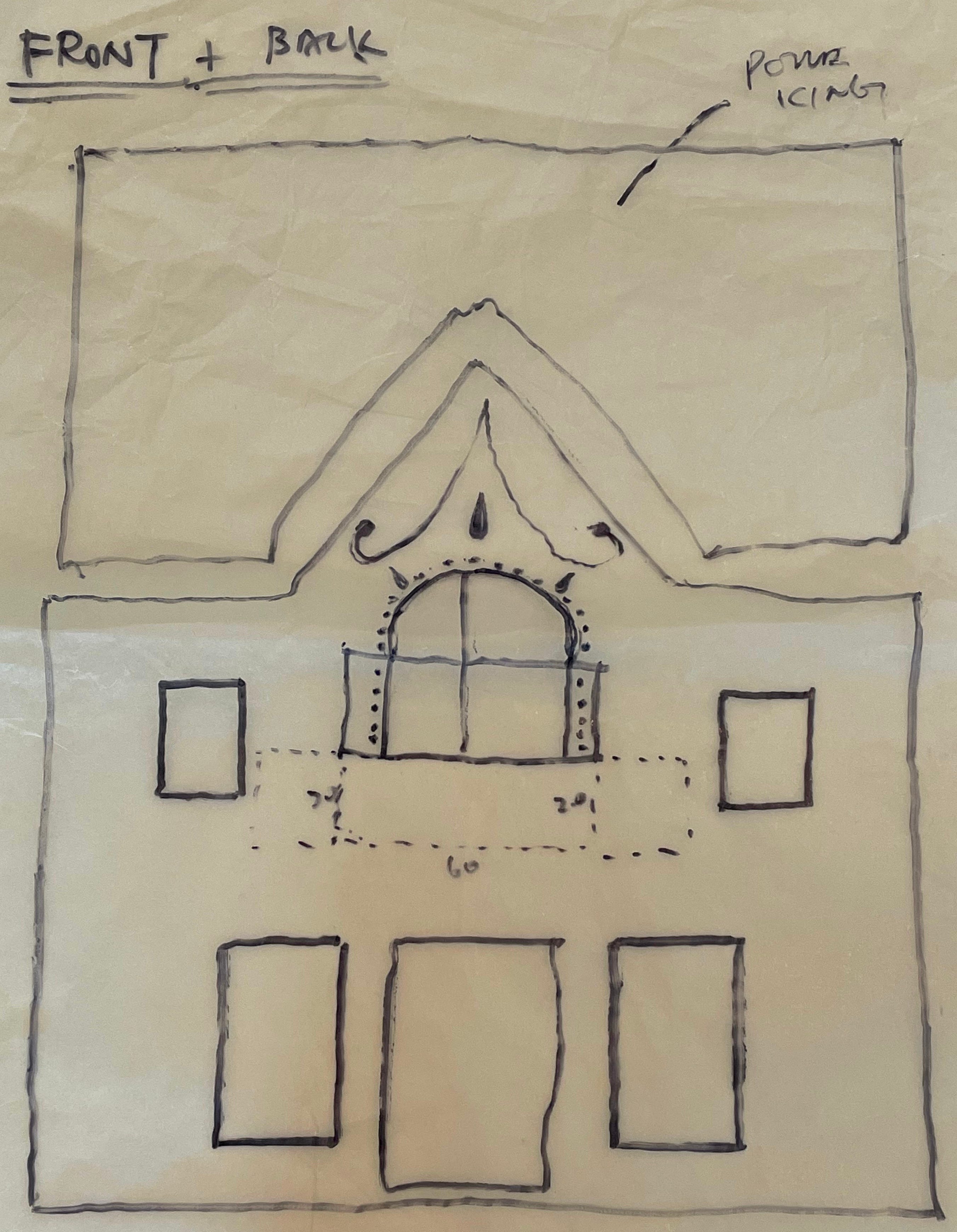
Andy and I had a planning meeting. He arrived with a role of tracing paper and a metal ruler. He told me he loved building models in architecture school and this was exactly like a model. He examined the gingerbread mold. “We can cut out the door and leave it ajar! We can build the balconies in three dimensions!” Not to be outdone, I said, “We can make marzipan snowmen!” Fallingwater was abandoned, but both of us were too polite to mention it.
In the next two days, all the ambitious planning fell by the wayside. It took four hours to bake the pieces of the gingerbread house with another hour of trimming and cutting. Sixteen hours later, we attempted to build the walls. As soon as we attached two, the third collapsed. We ended up joining the walls with an avalanche of icing, using odd kitchen items as supports to keep the thing upright while it dried. Every attempt to attach the roof to the four questionable walls failed since apparently the weight of the roof was too great for the walls. This sounded like a real-world problem that shouldn’t hold sway in the world of gingerbread. “Do we even need a roof?” I asked Andy. “Of course we need a roof!” the architect barked back.
Another hour went by and Andy had dinner reservations. “Can we use superglue?” he asked.
“Absolutely not!” I replied. This former pastry chef was outraged.
Andy suggested we take a break for tea. With Andy, all things can be handled with tea. More failed roof construction ensued even after Andy built gingerbread supports for the interior of the house in an attempt to shore up the walls.
Finally I said: “Oh for godssakes. Can’t you just build a roof?”
“OF COURSE I CAN BUILD A ROOF!” said Andy, marching off with his tracing paper and metal ruler. Ten minutes later, we had a roof, made of out of parchment paper. I thought it was glorious. “It’s not done!” snapped Andy, wielding a pastry bag. He carefully piped shingles on the parchment paper with icing. The parchment paper roof gave way on one corner and wouldn’t reattach. We didn’t care.
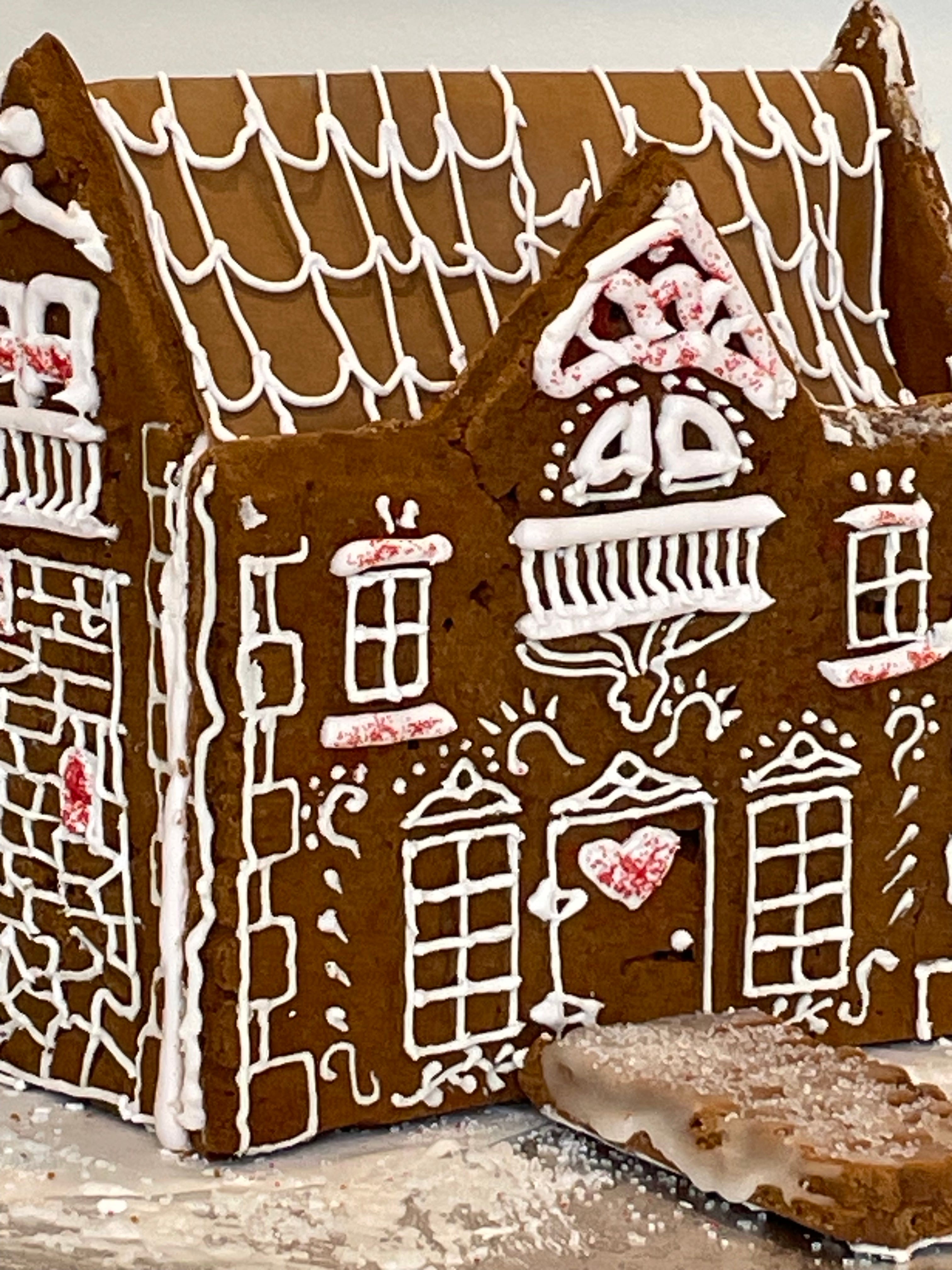
After two days of construction and untold pounds of confectioner’s sugar, we studied our gingerbread abode. “It’s not – bad,” said Andy.
Staring at our hapless little house, we both realized simultaneously the amount of drama and concern and planning and building not to mention years of training as an architect and a pastry chef seemed way out of proportion to the final product. I started to laugh. At first a little giggle, and then I couldn’t contain myself. We both burst out laughing, doubled over with the idea of so much work and so much time yielding such a little result. What the hell? We had every professional qualification for gingerbread house building! It had been a tough year, neither one of us had real jobs, and now, doing everything short of rolling around on my kitchen floor, we laughed and laughed until nothing made sense and then everything made sense and every single problem disappeared in a cloud of ginger and spice. What a fabulous sense of release! How glorious and accomplished we felt! What the hell indeed! It was Christmas! So many hours! So much icing! And now we had nothing but this little odd construction to show for it. Failure was such fun! How incredibly perfect!
Once we recovered, Andy took a portion of the former roof and positioned in front of the door, making a sort of front walk. “But Andy,” I said. “It’s not in proportion.” I don’t know why that was suddenly a concern of mine, but scale seemed important. Andy patiently explained, “It’s a transitional element from the gingerbread of the house to the cardboard of the base.”
Of course it was.
I sent a picture to my sister. “You have a leaky roof,” she replied, referring to the stubbornly unattached corner. “But it looks nice. What happened to the windows?”
The gingerbread house made its debut at a party the next day.
“You made that?” said each guest as they arrived at the buffet table. I couldn’t tell if this comment was positive or merely polite, but now with our little house available for public viewing and comment, I decided to take ownership. “Andy and I did,” I said proudly.
“Can we eat it?”
“No,” I replied.
A focus group of four-year-old guests weighed in. My granddaughter said, “Where are the gum drops on the roof?” poking the house with her little finger. I was speechless. How did she know about gum drops? How did she even know the word “gum drop”? This from someone who could barely see above the table!
“Can I eat it?” she asked.
“No,” I replied.
“Why?” she asked.
Some things are just not meant to be explained.
Eliza, also four, took her turn observing the gingerbread house. She pointed to Andy’s transitional item. “Is that a front walk?” she asked.
Andy looked me in smug triumph.
“Can I eat it?” she said.
“No,” he replied.
Ellis, the third member of the group, studied the construction for some time, periodically jabbing at it with his finger, as if testing the structural integrity. “This,” he finally said solemnly, “is a very nice gingerbread house.”
“Thank you, Ellis,” I replied. “I appreciate that.” My granddaughter is smart, charming and adorable, but if there was an audition for the role of “grandchild,” Ellis would get the part, no problem.
“You’re welcome,” he said. “Can I eat it?”
“What are you going to do with it after the holidays?” someone asked.
“Throw it out,” I cheerfully replied.
“Like Burning Man,” said Andy.
Exactly.
very, very cute! and it's a BEAUTIFUL gingerbread house. x